Reviews
A month of Luna Ultra field reports and the first Pocket 4P tests reveal two distinct approaches to the dual-lens gimbal camera. Insta360 leads on remote operation and 8K flexibility; DJI’s LOFIC sensor delivers remarkable highlight latitude, while both retain workflow limitations.
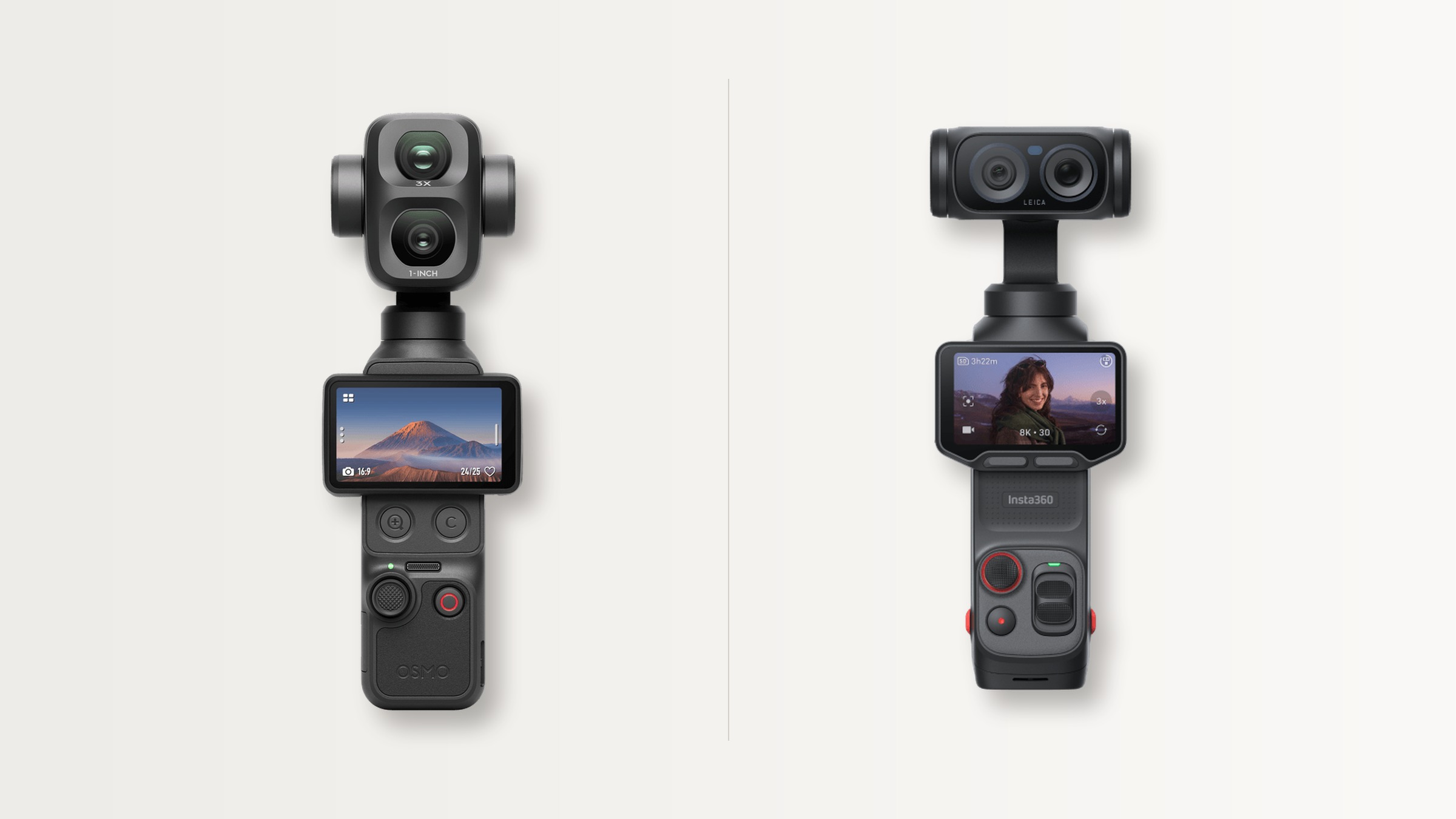
In the space of seven weeks, the pocket gimbal camera has changed more substantially than it did during the previous three years. Insta360’s Luna Ultra arrived in June with two focal lengths, 8K recording and a detachable wireless monitor. DJI has now answered with the Osmo Pocket 4P, pairing the familiar Pocket format with two cameras and a new one-inch LOFIC sensor.
The similarity is immediate. Both cameras combine a 20mm-equivalent wide lens with a 60mm-equivalent telephoto camera, three-axis mechanical stabilisation and a two-inch screen. Their bodies even weigh almost the same: 233g for the black Luna Ultra and 230g for the Pocket 4P. In practice, the early evidence describes two quite different tools.
LensDigest has not tested either retail camera. This analysis draws on manufacturer documentation, independent reviews, sample footage and owner reports available up to 30 July 2026. The evidence is uneven. Luna Ultra has been in reviewers’ and customers’ hands since June; Pocket 4P reaches the wider European market today, after an earlier Chinese release and a controlled preview programme. Conclusions about DJI’s long-term reliability, thermal behaviour and firmware are therefore provisional.
The 60mm view is the most consequential addition to both cameras. Earlier Pocket models were excellent at establishing shots, walk-and-talk filming and self-recording, but their wide fixed lens gave every sequence a recognisable visual grammar. A proper short telephoto allows tighter portraits, detail shots and cleaner backgrounds without asking the operator to move a gimbal within arm’s reach of the subject.
Neither device provides a continuous optical zoom. Each switches between two independent camera modules, with digital zoom covering the spaces beyond them. Reviewers of the Luna Ultra consistently found its telephoto camera useful in daylight. TechRadar’s Tim Coleman called the two lenses a meaningful part of the camera’s versatility, while PetaPixel and Engadget both found the 60mm view more persuasive than a simple specification-sheet novelty. Owners have reached much the same conclusion, particularly for travel details and portraits.
The cut between cameras still needs to be treated as a cut. Luna footage can show a change in framing and colour as the camera modules switch, and autofocus may take a moment to settle. An owner who travelled with the camera for a month reported that the jump was visible enough to discourage switching during a continuous take. DJI’s two cameras also use different sensor sizes, lenses and log options, so matching them will require attention in post even when the exposure and white balance are locked.
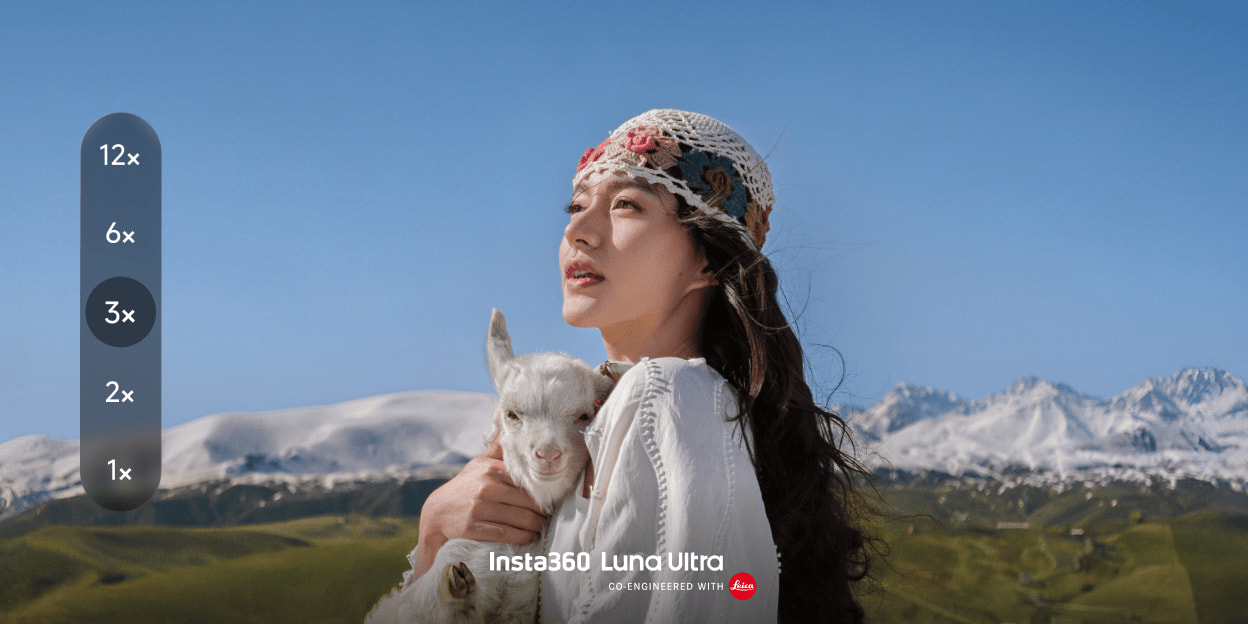
Luna Ultra’s main camera uses a one-inch-type sensor behind a 20mm-equivalent f/1.8 lens. The telephoto module uses a smaller 1/1.3-inch sensor with a 60mm-equivalent f/2 lens. It records 8K up to 30p, 4K up to 120p and Full HD up to 240p, with 10-bit I-Log and Dolby Vision among the available profiles. Insta360 advertises 14 stops of dynamic range, although we have not found a reproducible independent laboratory measurement that confirms that figure.
The reviews agree more readily on the appearance of the footage. PetaPixel found an obvious improvement over current phones, with less aggressive sharpening and compression. Engadget praised the detail, colour and highlight handling, and TechRadar described the main camera as capable of excellent results in daylight and low light. Leica’s involvement is expressed through colour modes rather than an optically branded lens. The Leica Vivid setting has proved popular with users who want an attractive image without grading, although its saturation will not suit every subject.
8K is useful when the delivery format is 4K or HD and the editor needs room to crop, stabilise or extract a second composition. PetaPixel’s close comparison also puts the benefit in proportion: at normal viewing sizes the improvement over well-recorded 4K is restrained, becoming clearer under a very large crop. The camera grows warm during 8K recording according to TechRadar, T3 and Notebookcheck, but none of those reviews established a pattern of shutdowns during ordinary use.
The data rate also places a ceiling on what 8K can preserve. Luna Ultra records H.265 at up to 120Mbps, which is approximately 54GB per hour at the maximum rate. Its 47GB of usable internal storage would hold about 52 minutes at that rate before audio and file-system overhead; actual recording time varies by mode. A microSD slot makes expansion straightforward, and Insta360’s current specification page lists support for cards up to 2TB.
Tracking and autofocus are the less settled parts of the Luna experience. TechRadar found subject tracking less dependable than DJI’s established implementation, and Notebookcheck saw autofocus hesitate with small subjects and while zooming. The camera can produce polished footage, but an operator filming an unscripted subject should watch the focus transition rather than assume that the gimbal has solved it.
PureVideo is intended for very dark scenes, combining noise reduction and image processing in camera. Notebookcheck considered it effective, while T3 found that it brought little improvement in scenes that were dim rather than genuinely dark. PureVideo cannot be combined with I-Log or Dolby Vision, which makes it an alternative capture path rather than an additional layer of latitude.
DJI’s wide camera also combines a one-inch-type sensor with a 20mm-equivalent lens, here at f/2. The important difference is the stacked LOFIC sensor. Lateral overflow integration capacitors give saturated pixels somewhere to place excess charge before the highlight clips, allowing the sensor to hold a much wider range within a single exposure. DJI claims up to 17 stops in D-Log2 on the wide camera at 1×.
That headline number needs context. During PetaPixel’s preview testing, Jordan Drake exposed a demanding high-contrast scene one third of a stop below clipping and compared the result with a Panasonic Lumix S1 II. Once graded, the Pocket 4P retained a remarkably similar balance of highlight and shadow information. This was a practical comparison rather than a formal measurement of total dynamic range, but the result is significant for a camera of this size.
Gamut’s technical profiling adds useful detail. Its chart work found approximately ten stops above middle grey before clipping in D-Log2, with middle grey sitting around 31 IRE. That does not mean the camera has only ten stops of total dynamic range: it describes the highlight allocation above middle grey. It does show how DJI has reserved an unusually large portion of the signal for bright detail. The lower middle-grey placement also means that casual exposure by eye can leave the image darker than expected.

D-Log2 is currently available only on the 1× wide camera. The 60mm-equivalent telephoto camera records DJI’s existing D-Log instead. At launch, DaVinci Resolve does not include a native D-Log2 colour-space transform, and Gamut found that DJI’s D-Log and D-Log2 transforms are not interchangeable. Editors who mix the two focal lengths will need the correct DJI LUTs or a profiled colour workflow, followed by a visual match between the cameras.
DJI’s official specifications list 4K slow motion up to 240fps on the wide camera and 200fps on the telephoto. The tele camera uses a 1/1.28-inch sensor and a 60mm-equivalent f/1.8 lens. DJI estimates its depth of field as roughly equivalent to f/6.3 on full frame, enough to separate a close subject without making focus excessively fragile.
The first generalist hands-on reports are promising. Tom’s Guide, filming for three days in Malta, found the stabilisation excellent and the default footage natural, with convincing control of highlights and shadows. That report was conducted under pre-launch restrictions, so it provides a useful visual impression rather than a complete assessment of the finished retail camera.
Both cameras make very large claims for capture latitude while offering limited exposure instruments on their built-in screens. Luna owners have asked for false colour or a histogram, particularly when recording I-Log. One early owner documented coloured artefacts around clipped highlights and high-contrast edges on firmware 1.011; the same user reported clean, flexible files when exposure was controlled. We have not found enough matching reports to call this a general fault, but it is a sensible reason to protect highlights until subsequent firmware and broader testing clarify the behaviour.
Pocket 4P owners have similarly criticised the absence of zebras, despite D-Log2’s expanded highlight range. DJI’s published controls do not list waveform, false colour or zebras. LOFIC increases the sensor’s ability to retain bright detail, but it does not tell the operator where clipping begins. For a professional log workflow, that information remains more useful than another stop printed on the box.
Insta360’s two-inch OLED screen detaches from the body and continues to show a live image. It can start and stop recording, reframe the gimbal, change settings and serve as a fourth microphone. This allows the camera to sit on a car, a low stand or the far side of a room while the operator monitors from a more useful position. TechRadar, Engadget and T3 all considered the system genuinely helpful rather than ornamental.
The limits are environmental. Insta360 quotes a 20-metre range in an unobstructed space. In response to an owner reporting a weak signal indoors, its support team said that eight metres is more typical in a complex wireless environment. A month-long travel report also mentions lag in crowded locations. That is still enough range for many locked-off or self-shooting arrangements, but the link should be tested before a one-take event.
DJI retains a conventional fixed touchscreen and the more familiar Pocket control scheme. Its advantage is maturity. ActiveTrack has been refined over several generations, and the first Pocket 4P reports describe the stabilisation and subject following as assured. The new model can track at up to 12× digital zoom, although magnified digital footage should be judged independently of the tracking claim.
Luna Ultra supports timecode and direct wireless connection to two Insta360 microphones. It has four microphones in total when the detachable monitor is counted. Pocket 4P carries three built-in microphones and connects directly to two DJI microphone transmitters. Both systems can create a remarkably small interview or presenter kit; the choice is likely to follow whichever wireless audio system the operator already owns.
Insta360 claims up to 240 minutes and DJI up to 210 minutes. Both figures were measured at 1080p24 with the screen and Wi-Fi disabled, conditions that do not resemble normal gimbal-camera use. Notebookcheck recorded roughly two and a half hours from Luna Ultra during mixed shooting. TechRadar’s continuous higher-resolution test was closer to 75 minutes. Comparable sustained 4K testing of retail Pocket 4P units is still too scarce for a useful judgement.
The charging claims are more relevant on a working day. Insta360 says Luna Ultra reaches 80 per cent in 23 minutes; DJI gives 18 minutes for Pocket 4P with a compatible charger. Pocket 4P includes 103GB of built-in storage, more than double Luna Ultra’s 47GB, and both accept microSD cards.
For handheld operation their weight is effectively identical. The difference is in shape and handling rather than the scale: reviewers found Luna Ultra broader and less discreet than earlier single-camera Pocket models, while DJI’s 4P is itself substantially larger than the Pocket 3 generation. Neither is a trouser-pocket camera in every outfit once a protective case, wireless microphones and filters are added.
The Luna owner reports broadly reinforce the published reviews. The 60mm view, Leica Vivid colour and detachable monitor are the features people continue to use after the novelty has faded. The repeated reservations concern heat during 8K, large files, a visible transition between lenses and occasional monitor lag. Isolated reports also describe autofocus hesitation or a small hiccup during a pan. These accounts are useful warnings, but they do not yet establish failure rates.
Pocket 4P owner feedback is younger and consequently less reliable as a guide to long-term behaviour. Early users are pleased with D-Log footage and the image from both focal lengths. The first workflow questions concern D-Log2’s restriction to the wide camera, the lack of a native Resolve transform and exposure monitoring. One owner chose standard D-Log for a complete edit so that both cameras could be treated consistently. At this stage, scattered questions about heat should not be converted into an overheating narrative without repeatable tests on retail firmware.
Luna Ultra currently makes the stronger case for solo operators who need remote placement, timecode or an 8K master from a very small rig. Its detachable display changes where the camera can be put, and I-Log already has a clearer route into DaVinci Resolve 21. The telephoto camera is valuable, its straight-out colour can be attractive, and the price includes a control idea that DJI does not offer.
Pocket 4P is the more compelling option when highlight retention and high-frame-rate 4K take priority. The wide camera’s LOFIC performance is the most technically impressive result in the early evidence, and DJI’s established tracking and gimbal behaviour reduce risk for self-shooting. It also enters Spain at €599 for the standard package, below Luna Ultra’s typical European price of about €729, and provides substantially more internal storage.
There are qualifications on both sides. Luna’s tracking and lens transition need watching, and 47GB is restrictive for an 8K camera. Pocket 4P’s best log mode applies to only one camera, its new colour science needs a deliberate post-production path, and its wider retail history can currently be counted in days. US availability also differs: Insta360 sells Luna Ultra officially for $769.99, while DJI has not announced a US retail release for Pocket 4P.
The dual-camera design has done more than add reach. It has made these gimbals credible sequence-building cameras: a wide view for movement and context, followed by a 60mm shot for faces and details. The first reviews suggest that both manufacturers have implemented the idea well enough for the second camera to survive beyond the launch demonstration.
Luna Ultra is the more adventurous physical design. Its detachable monitor, 8K recording and timecode support give a small crew options that would otherwise require more rigging. Pocket 4P concentrates its ambition in the image pipeline, where LOFIC and D-Log2 produce highlight latitude that would have seemed implausible in this format a generation ago.
A definitive comparison needs controlled rolling-shutter, dynamic-range, thermal and autofocus tests on current retail firmware. For now, the evidence supports a narrower conclusion. Luna Ultra is the better-documented choice for flexible solo operation; Pocket 4P has the more promising wide-camera image and the lower European entry price. The right purchase depends less on 8K versus 17 stops than on how the footage will be monitored, matched and edited.
This article synthesises official documentation, independent tests and owner reports available on 30 July 2026. Manufacturer specifications and claims are identified as such; Reddit posts are treated as individual accounts rather than representative evidence.