News
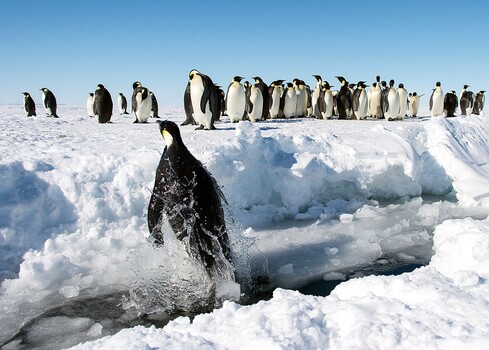
Emperor penguin colonies, invisible to satellites due to the birds' small size relative to pixel resolution, can be detected from orbit by their large, reddish-brown guano stains. Scientists use this high-contrast byproduct, which covers tens or hundreds of meters of ice, as the subject for mapping. Coarse resolution satellites like Landsat and Sentinel-2 are used for initial detection, while very high-resolution commercial satellites like WorldView-3 are employed for counting by resolving individual penguin huddles.
Emperor penguins are too small to be detected by satellite imagery, but their guano stains are large enough.
Guano stains provide high contrast against the white Antarctic ice, making them detectable from orbit.
Coarse resolution satellites identify colony locations, while high-resolution satellites are used for counting.
The technique relies on identifying indirect evidence, similar to photographers focusing on shadows or wakes.