SUMMARY
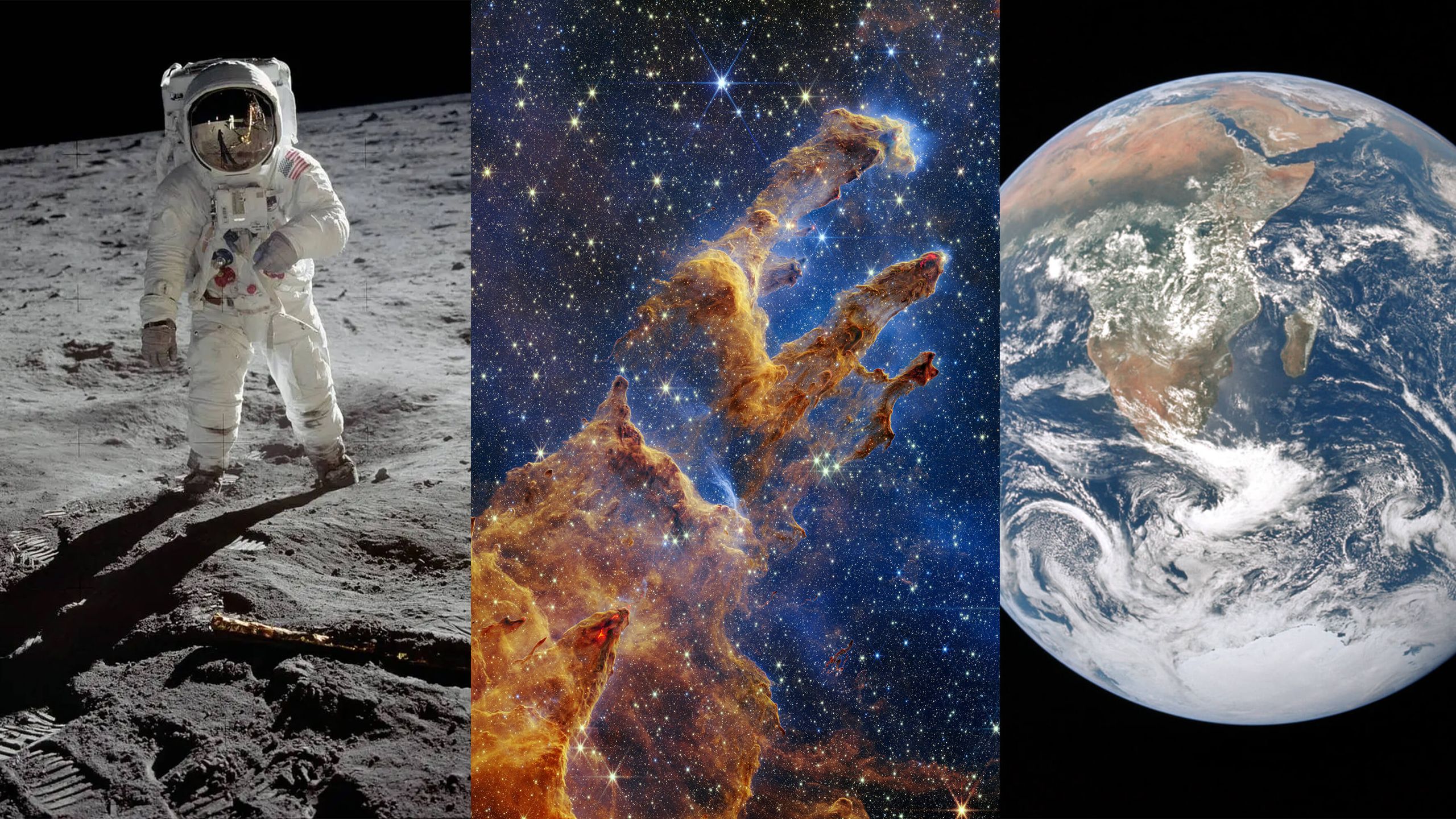
Since 1958, NASA has utilized photography from astronauts and spacecraft to significantly advance our understanding of Earth and the cosmos. Iconic images like the 'Man on the Moon' (1969) captured with a Hasselblad 500EL, the 'Blue Marble' (1972) showing Earth from space, and the 'Pale Blue Dot' (1990) from Voyager 1 have redefined our perspective. More recently, the Hubble and James Webb telescopes have provided stunning visuals of celestial phenomena like the 'Pillars of Creation' and the 'Hubble Extreme Deep Field', visualizing star birth and ancient galaxies.
TAKEAWAYS
NASA imagery has been crucial in understanding Earth, the universe, and humanity's place in the cosmos.
Iconic photos like 'Man on the Moon' and 'Blue Marble' were captured using Hasselblad cameras.
Voyager 1's 'Pale Blue Dot' image emphasized the vastness of space and Earth's smallness.
Telescopes like Hubble and James Webb continue to provide groundbreaking images of star formation and distant galaxies.