Opinion
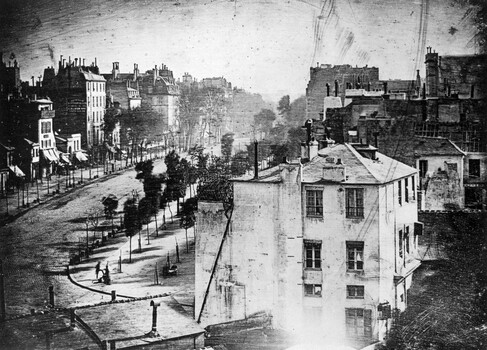
Louis Daguerre's 1838 daguerreotype, "Boulevard du Temple," is the earliest known surviving photograph to feature recognizable people. The image of a Paris street appears empty due to long exposure times, which caused moving objects like carriages and pedestrians to fade away. However, a man having his boots shined, along with his bootblack, remained stationary for several minutes, allowing them to be captured on the silver plate. This accidental inclusion of human figures marks a unique moment in photographic history, as the subjects were not intentionally posed.
The earliest identifiable humans in a surviving photograph are seen in Louis Daguerre's 1838 "Boulevard du Temple."
Long exposure times (several minutes) caused moving elements of the busy Paris street to disappear.
A man getting his boots shined and the bootblack were captured because they remained still.
The photograph was made from Daguerre's studio window and is a laterally reversed mirror image.