SUMMARY
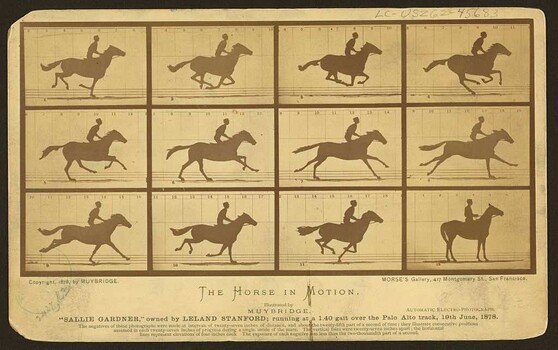
In 1878, photographer Eadweard Muybridge used a battery of twelve cameras, triggered by threads, to capture a thoroughbred horse named Sallie Gardner at a full gallop. This experiment settled a centuries-old debate among artists and horsemen by definitively proving that a galloping horse has all four hooves off the ground at the same time. The images revealed this moment occurs when the horse's legs are gathered underneath its body, contrary to the popular 'rocking horse' pose depicted in art. Muybridge's work not only provided a scientific tool for studying animal locomotion but also laid foundational groundwork for the development of motion pictures.
TAKEAWAYS
Muybridge's 1878 experiment used twelve cameras triggered by threads to photograph a galloping horse.
The photographs proved that horses have all four feet off the ground simultaneously during a gallop.
This finding corrected centuries of artistic depictions of horse movement.
The sequential photography technique pioneered by Muybridge was an early step towards motion pictures.