Review
DSLR / CAMERA REFERENCE
K-5
Pentax
Catalogue announcement:
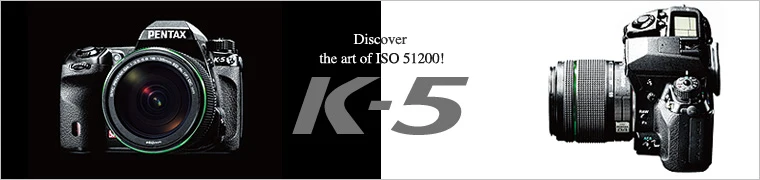
01 / TECHNICAL RECORD
Specifications
Catalogue specifications. Source: DPReview historical specification record ↗.
Sensor and files
- Effective pixels
- 16 megapixels
- Sensor size
- APS-C (23.7 x 15.7 mm)
- Sensor type
- CMOS
- Max resolution
- 4928 x 3264
- ISO
- Auto, 100 to 12800, in 1, 1/2, 1/3 EV steps (80 to 51200 Extended)
- Boosted ISO (minimum)
- 80
- Boosted ISO (maximum)
- 51200
- Uncompressed format
- RAW
Lens and focus
- Lens mount
- Pentax KAF2
- Number of focus points
- 11
- Manual focus
- Yes
- Image stabilization
- Sensor-shift
Exposure and shooting
- Minimum shutter speed
- 30 sec
- Maximum shutter speed
- 1/8000 sec
- Continuous drive
- 7.0 fps
- Exposure compensation
- ±5 (at 1/3 EV, 1/2 EV steps)
- Metering modes
- MultiCenter-weightedSpot
- Aperture priority
- Yes
- Shutter priority
- Yes
- Built-in flash
- Yes (Pop-up)
- External flash
- Yes (Hot-shoe, Wireless)
- Timelapse recording
- Yes
Video and audio
- Resolutions
- 1920 x 1080 (25 fps), 1280 x 720 (25, 30 fps), 640 x 424 (25, 30 fps)
- Format
- Motion JPEG
- Microphone
- Stereo
Viewfinder and screen
- Viewfinder type
- Optical (pentaprism)
- Viewfinder coverage
- 100%
- Viewfinder magnification
- 0.92× (0.61× 35mm equiv.)
- Screen size
- 3″
- Screen dots
- 921,000
- Articulated LCD
- Fixed
- Touch screen
- No
Body and connections
- Storage types
- SD/SDHC/SDXC
- Battery description
- Lithium-Ion D-LI90 rechargeable battery & charger
- Battery Life (CIPA)
- 980
- Weight (inc. batteries)
- 740 g (1.63 lb / 26.10 oz)
- Dimensions
- 131 x 97 x 73 mm (5.16 x 3.82 x 2.87″)
- Environmentally sealed
- Yes (Weather and dust resistant)
- USB
- USB 2.0 (480 Mbit/sec)
- HDMI
- Yes
- Remote control
- Yes (optional, wired or wireless)
02 / INDEPENDENT COVERAGE
Reviews and field reports
03 / PROVENANCE
Sources and dates
A catalogue year identifies the year held in the source dataset. Announcement dates and retail months are labelled separately. Specifications can vary by region, firmware and recording mode; use the linked manufacturer documentation for those conditions.
Archive updated 2026-10-04. Archive coverage and dataset credits →