Mirrorless / CAMERA REFERENCE

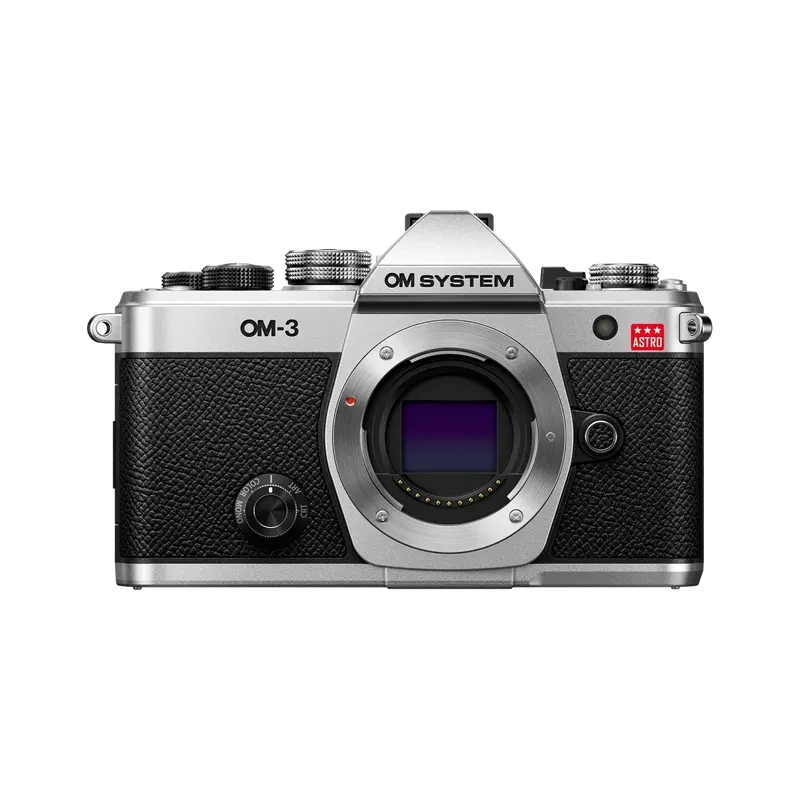
OM-3 ASTRO

OM SYSTEM

Announced:

27 February 2026 release in Japan.

The OM-3 ASTRO uses a modified infrared-cut filter to admit hydrogen-alpha light from emission nebulae. Its night-sky presets and stacking functions reduce setup work, although the changed filter also affects daylight colour. It remains an interchangeable-lens Micro Four Thirds camera.

OM SYSTEM OM-3 ASTRO
Photo: OM SYSTEM ↗

01 / TECHNICAL RECORD

Specifications

Official specifications checked 4 October 2026. Source: Manufacturer specifications ↗.

Imaging and operation

Sensor
20.4MP stacked BSI Live MOS; 17.3 × 13mm
Lens mount
Micro Four Thirds
Processor
TruePic X
Astro filter
Modified IR-cut filter; manufacturer lists 100% Hα transmission
Autofocus
1053 cross-type phase-detection points; Starry Sky AF
High-resolution stacking
12 exposures combined in Handheld High Res Shot
Stabilisation
Five-axis sensor shift; up to 6.5 stops at centre, or 7.5 with compatible Sync IS lens, CIPA conditions
Viewfinder
2.36-million-dot OLED
Rear display
3-inch vari-angle touch LCD; 1.62 million dots
Body
Magnesium alloy; IP53-rated weather protection
Video
4K up to 60p
Battery
BLX-1 rechargeable battery

02 / INDEPENDENT COVERAGE

Reviews and field reports

Field test · brand ambassador

Amateur Photographer · OM-3 ASTRO field test ↗

Peters, an OM System ambassador, found Night Vision and Starry Sky AF useful when composing and focusing in the dark. He noted that the stacked sky image still needed a separate foreground exposure, and criticised the lack of a wired remote or tracker connection. His test also shows the pronounced daylight colour shift.

03 / PROVENANCE

Sources and dates

Announcement and first-release dates are labelled separately; availability can vary by market. Specifications can vary by region, firmware and recording mode; use the linked manufacturer documentation for those conditions.
Archive updated 2026-10-04. Archive coverage and dataset credits →