Review
Compact / CAMERA REFERENCE
PowerShot D20
Canon
Catalogue announcement:
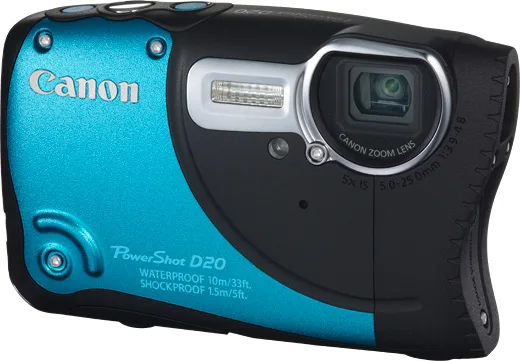
01 / TECHNICAL RECORD
Specifications
Manufacturer specifications. Source: Canon Camera Museum ↗.
Manufacturer specifications
- Camera Effective Pixels
- Approx. 12.1 million pixels
- Lens Focal Length
- 5x zoom: 5.0 (W) – 25.0 (T) mm (35mm film equivalent: 28 (W) – 140 (T) mm)
- Waterproof Capability
- IEC/JIS protection class “IPX8″ equivalent*1 For use within a depth of 10 meters up to 60 minutes.
- Dustproof Capability
- IEC/JIS protection class “IP6X” equivalent *1
- Shock Resistant Capability
- Canon standard based on MIL Standard 810F Method 516.5 Selecting Procedure IV (A US Defense Standard)*1*2 cleared
- LCD Monitor
- 3.0 type color TFT LCD Effective Pixels: Approx. 461,000 pixels
- File Formats
- Design rule for Camera File system, DPOF (version 1.1) compliant
- Data Types
- Still Images: Exif 2.3 (JPEG) Movies: MOV (H.264 video data, Linear PCM (2 channel monaural) audio data) GPS log files: NMEA 0183 message format compliant
- Interfaces
- Hi-speed USB HDMI output Analog audio output (monaural) Analog video output (NTSC/PAL)
- Power
- Battery Pack NB-6L AC Adapter Kit ACK-DC40
- OperatingTemperature*3
- -10 – 40 °C (14 – 104 °F)
- Dimensions (Based on CIPA Guidelines)
- 112.3 x 70.8 x 28.0 mm (4.42 x 2.79 x 1.10 in.)
- Weight (Based on CIPA Guidelines)
- Approx. 228g (approx. 8.04 oz.; including battery and memory card) Approx. 205g (approx. 7.23 oz.; camera body only)
- Maximum telephoto
- 1.0 – 3.0 m (3.3 – 9.8 ft.)
- Maximum Telephoto
- 1 m (3.3 ft.) – infinity
- Continuous Shooting Speed
- Approx. 1.9 shots/sec.
- Range in all shooting modes
- 15 – 1/1600 sec.
02 / INDEPENDENT COVERAGE
Reviews and field reports
03 / PROVENANCE
Sources and dates
A catalogue year identifies the year held in the source dataset. Announcement dates and retail months are labelled separately. Specifications can vary by region, firmware and recording mode; use the linked manufacturer documentation for those conditions.
Archive updated 2026-10-04. Archive coverage and dataset credits →